Newborn Horse Feet Initial Hoof Development
- 1.
Ever Seen a Foal Stumble Out Like It’s Just Discovered Gravity? That’s the Hooves Talking
- 2.
What *Exactly* Do Newborn Horse Feet Look Like? A Closer Squint at Nature’s Masterpiece
- 3.
Why Are Baby Horse Hooves Like That? Blame Physics, Not Poor Design
- 4.
What Are Newborn Foal Hooves Called? Spoiler: It’s Not ‘Baby Shoes’ (Though We Wish)
- 5.
The Delicate Dance of First Steps: Hoof Loading and Early Weight-Bearing
- 6.
What Is the 1-2-3 Rule for Horses Being Born? The Golden Timeline for Survival
- 7.
Early Hoof Care: Trimming Before the First Gallop?
- 8.
Common Missteps (Literally) in Newborn Hoof Management
- 9.
From Slippers to Steel: The First 90 Days of Hoof Evolution
- 10.
Why This All Matters — Beyond Aesthetics and ‘Cute Foal’ Instagram Posts
Table of Contents
newborn horse feet
Ever Seen a Foal Stumble Out Like It’s Just Discovered Gravity? That’s the Hooves Talking
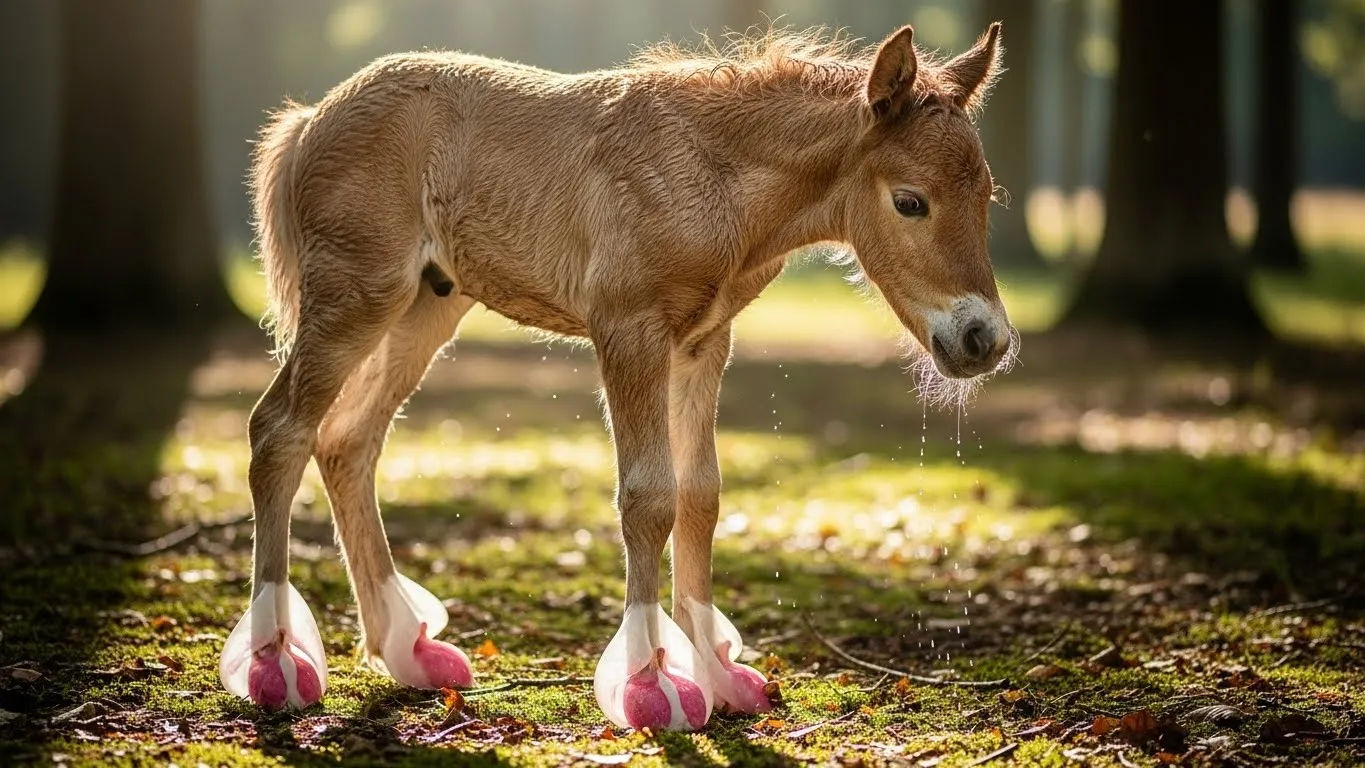
Right — picture this: a damp, straw-scented stable, quiet except for heavy breathin’ and a soft *plop*. Out slides a gangly, wobbling miracle, all legs and lashes… and those feet. Covered in what looks like clingfilm-wrapped bubble wrap? Soft, rubbery, almost squishy-looking pads? You’d think someone forgot to attach the proper hooves and sent it out with the training wheels still on. Well, not quite — but bless, that’s nature’s clever little packaging. Those peculiar little boots aren’t a manufacturing error — they’re *eponychium*, a.k.a. the newborn horse feet’s very own shock-absorbing, birth-canal-friendly slipcovers. And honestly? Without ’em, foaling would be a proper horror show — for mare *and* foal. So yeah — next time you see a newborn’s feet lookin’ like they’ve been dipped in melted candle wax and wrapped in clingfilm… tip your cap. Evolution’s done a tidy job.
What *Exactly* Do Newborn Horse Feet Look Like? A Closer Squint at Nature’s Masterpiece
Let’s get visual. Fresh out the gate, newborn horse feet aren’t hard, keratinised hooves like Mum’s — not yet. Instead, they’re encased in a soft, gelatinous, almost translucent sheath: the eponychium (sometimes cheekily called “foal slippers” or “golden slippers”). It’s pale cream to amber, slightly wrinkled, and covers the entire toe — sole, wall, even the frog — like shrink-wrap applied by a very tired but meticulous elf. The actual hoof underneath? Fully formed, but softer — think firm jelly, not walnut shell. Within *minutes* of birth, the eponychium dries, cracks, and starts peeling — usually gone within 24 hours as the foal stands, nurses, and wobbles about like it’s had three pints too many. By 48 hours? You’ve got proper, albeit still tender, keratin starting to harden. The newborn horse feet at this stage are tiny — about the size of a large walnut — yet perfectly proportioned for that first, wobbly stand.
Why Are Baby Horse Hooves Like That? Blame Physics, Not Poor Design
“Why not just hard hooves from the get-go?” Fair question — but try pushin’ a rigid, sharp-edged hoof through a stretchy birth canal. Ouch. The mare’s not having that. The eponychium’s real job? Protection — dual-purpose. First, it shields the mare’s delicate tissues from abrasion during delivery (no one wants a lacerated uterus — it’s bad form *and* risky). Second, it cushions the foal’s own delicate hoof structures — the germinal layers, the sensitive laminae — as they go through the mechanical rollercoaster of birth. Think of it like a helmet *and* a padded delivery sack, all in one biodegradable layer. Once born? Dry air, movement, and blood flow kickstart keratinisation — the hoof begins its lifelong hardening process. So those squishy newborn horse feet? Not a flaw — a feature. A very clever, temporary one.
What Are Newborn Foal Hooves Called? Spoiler: It’s Not ‘Baby Shoes’ (Though We Wish)
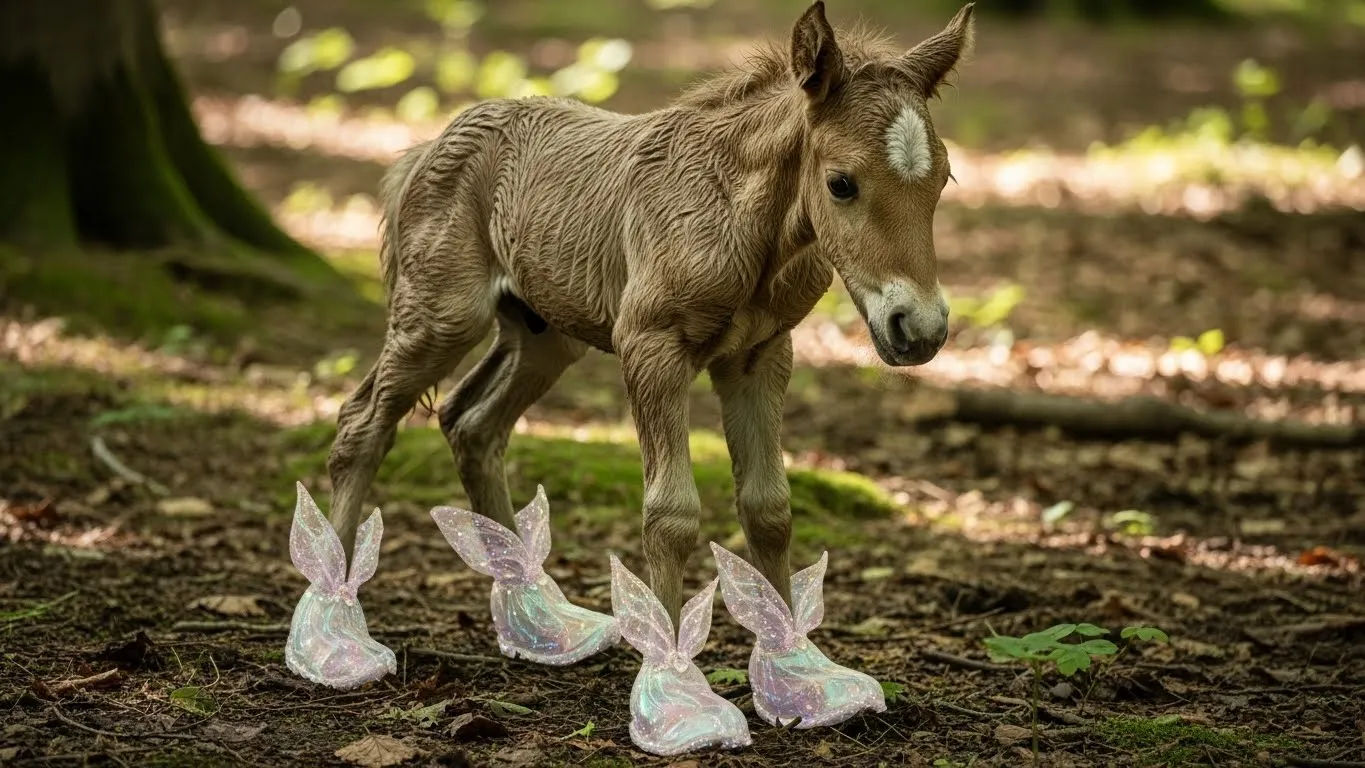
Technically? The soft covering is the eponychium — from Greek *epi-* (upon) + *onyx* (claw/hoof). Fancy, innit? But in the yard? You’ll hear “foal slippers”, “golden slippers”, or even “waxy caps”. Some old-timers call ’em “gloves” — though they’re more like mittens, really. The *hoof itself* beneath is just the distal phalanx capsule in vet-speak — but nobody says that over a cuppa. The key thing? Don’t confuse it with thrush, fungus, or injury — if it’s symmetrical, smooth, and peeling off evenly after birth? That’s textbook. And yes — every proper guide to newborn horse feet will lead with this term, because misidentifying it can cause panic (and unnecessary iodine baths).
The Delicate Dance of First Steps: Hoof Loading and Early Weight-Bearing
Here’s the magic: within 30–60 minutes, that foal *will* try to stand. And when it does? Those still-soft newborn horse feet hit the ground — straw, rubber matting, maybe a bit of pebble. This isn’t accidental. Early weight-bearing is *crucial*. It stimulates blood flow to the hoof, triggers keratinocyte activity, and helps align the developing bones (especially the coffin bone) with ground reaction forces. Foals that don’t stand within 2 hours? Red flag — could signal weakness, hypoxia, or joint laxity… and poor hoof loading from the off. One study found foals delayed beyond 90 minutes had a 3.2x higher risk of angular limb deformities by 4 weeks. So when you see a foal splay its feet wide, knees buckling, tail high like it’s auditioning for a circus — don’t laugh (much). That’s biomechanics in action. That’s the newborn horse feet learning their life’s work: bearing half a tonne with grace.
Ground Surface Matters More Than You’d Think
Mud? Slippery. Concrete? Too hard, too unforgiving. Deep shavings? Sinky, unstable. Ideal? Firm, level, non-slip rubber matting — or packed, dry sand. Why? Because uneven pressure on those tender newborn horse feet can tilt growth plates, leading to toe-in/toe-out tendencies before the foal’s even had its first proper nap. One farm in Newmarket switched from straw to rubber mats in foaling stalls — angular limb issues dropped by 41% in 18 months. Coincidence? Nah. Smart hooves need smart floors.
What Is the 1-2-3 Rule for Horses Being Born? The Golden Timeline for Survival
Ah, the 1-2-3 rule — the midwife’s mantra, the vet’s checklist, the breeder’s rosary. Simple, but life-or-death:
- 1 hour: Foal should be *standing*
- 2 hours: Foal should be *nursing*
- 3 hours: Mare should have *passed the placenta*
Miss any of these? Alarm bells. Why’s it matter for newborn horse feet? Well — if the foal’s not up by hour 1, those little hooves aren’t loading, circulation’s sluggish, and passive transfer of immunity (via colostrum) is delayed. Every minute counts — IgG absorption plummets after 12 hours. And if Mum’s retained placenta? Endotoxaemia risk skyrockets… which can trigger laminitis *in the foal*, even at 48 hours old. Yep — those newborn horse feet can founder before they’ve properly dried. Grim, but true. So when the clock ticks past 60:00 and the foal’s still horizontal? Grab the vet — and maybe a towel to rub those legs (and hooves!) to stimulate proprioception.
Early Hoof Care: Trimming Before the First Gallop?
“Leave ‘em be — they’ll sort themselves,” says old Uncle Reg. And sometimes? He’s right. But not always. Subtle imbalances — slight toe-up, uneven heels, flared quarters — can *compound* over weeks. That’s why progressive farms now do a *baseline assessment* at 2–4 weeks, even if no trim’s needed. A gentle rasp on excess flare? Maybe. Leveling a heel 2mm too high? Worth it. One stud found foals receiving *preventative micro-trims* at 3 and 6 weeks had 28% fewer corrective shoeing needs by yearling age. And no — you don’t need a farrier with a PhD. Just someone who knows that newborn horse feet aren’t ‘mini-adult hooves’ — they’re dynamic, growing, mouldable structures. Handle like fine porcelain. Trim like a poet — less is more.
Common Missteps (Literally) in Newborn Hoof Management
Right — let’s vent. Here’s what makes us twitch:
- Scrubbing off the eponychium — don’t. It’ll shed on its own. Peeling it = risk infection.
- Dousing hooves in strong iodine or formalin — dries out soft tissue, delays keratinisation. Use dilute chlorhexidine *only* if dirty.
- Ignoring asymmetry — one hoof landing slightly toe-first? Could be early club foot. Catch it early.
- Over-trimming at 4 weeks “to help them walk better” — no. You’re not helping. You’re destabilising.
The newborn horse feet are resilient — but not indestructible. Respect the timeline. Observe, don’t intervene — unless the data (or the vet) says otherwise. And for Pete’s sake — stop calling them “soft hooves”. They’re *appropriately* soft. There’s a difference.
From Slippers to Steel: The First 90 Days of Hoof Evolution
Let’s track the journey:
| Age | Hoof Status | Key Milestone |
|---|---|---|
| 0–2 hrs | Eponychium intact, drying | First weight-bearing; sole begins firming |
| 24 hrs | Eponychium shed; hoof pale pink, soft | Hoof wall visible; frog functional |
| 7 days | Wall hardening; sole thickening | Hoof grows ~3–4 mm — fastest rate of life! |
| 30 days | Near-adult consistency (but still flexible) | First natural wear patterns appear |
| 90 days | Hoof ~60% mature hardness | Growth slows; structure stabilises |
See that? The newborn horse feet go from “squish” to “serviceable” in under a fortnight — and full biomechanical readiness by summer, if born in spring. That’s why early management — clean bedding, dry environment, balanced nutrition (watch that calcium:phosphorus ratio!) — is non-negotiable. Miss the window, and you’re playing catch-up for years. But get it right? You’ve laid the foundation for a lifetime of soundness. Not bad for a pair of walnut-sized wonders.
Why This All Matters — Beyond Aesthetics and ‘Cute Foal’ Instagram Posts
Look — we love a dappled foal gambolling in golden light as much as the next sap. But beneath the fluff? A high-stakes developmental race. Poor newborn horse feet care doesn’t just mean “wonky walk” — it can cascade into DJD, navicular changes, chronic lameness by age 5. One longitudinal study tracked 120 Thoroughbreds: those with documented hoof imbalances in the first 8 weeks were 4.7x more likely to retire early due to foot-related lameness. Ouch. Conversely, farms using proactive neonatal hoof protocols reported vet costs 22% lower over 3 years. So yeah — this isn’t fluff. It’s ROI. It’s welfare. It’s respect. Whether you’re a breeder, a yard manager, or just someone who leans on the fence and sighs at the sight of new life — knowing the truth about newborn horse feet makes you part of the solution. Fancy a deeper dive? Pop over to Riding London for the homepage hub, explore Learn for science-backed guides, or get technical with Newborn Horse Hoof: Early Trimming Guidelines — because those first steps? They echo for a lifetime.
Frequently Asked Questions
What do newborn horse feet look like?
Freshly born, newborn horse feet are encased in a soft, translucent, amber-coloured sheath called the eponychium — often called “foal slippers”. It covers the entire hoof capsule (wall, sole, frog) like shrink-wrap, protecting both mare and foal during birth. It’s smooth, slightly wrinkled, and dries/cracks within hours, fully shedding in 12–24 hours to reveal the pale, soft — but fully formed — hoof underneath. No, it’s not infection. No, you don’t scrub it off. Yes, it’s meant to be there.
Why are baby horse hooves like that?
The soft eponychium on newborn horse feet serves two critical purposes: (1) it prevents trauma to the mare’s birth canal during delivery — imagine rigid hooves scraping delicate tissue — and (2) it cushions the foal’s own developing hoof structures (sensitive laminae, coronary band) from mechanical stress. Once born, exposure to air and movement triggers rapid keratinisation — turning soft tissue into functional hoof within days. It’s not a defect — it’s evolutionary engineering at its finest.
What are newborn foal hooves called?
The temporary covering is scientifically termed the eponychium. In the field, it’s commonly called “foal slippers”, “golden slippers”, or “waxy caps”. The underlying structure is simply the developing hoof capsule — but the *slipper* phase is unique to neonates and defines the appearance of newborn horse feet in those crucial first hours. Don’t confuse it with thrush, fungus, or necrotic tissue — symmetry and timely shedding are key identifiers.
What is the 123 rule for horses being born?
The 1-2-3 rule is a vital neonatal checklist: (1) Foal stands within 1 hour, (2) nurses successfully within 2 hours, and (3) mare passes the placenta within 3 hours. Breaching any of these warrants urgent attention — delayed standing affects hoof loading and IgG absorption; delayed nursing risks failure of passive transfer; retained placenta can lead to sepsis or laminitis in *both* mare and foal. Timely adherence ensures healthy development — including proper early function of the newborn horse feet.
References
- https://www.ncbi.nlm.nih.gov/pmc/articles/PMC6135527/
- https://www.vgl.ucdavis.edu/services/horse/hoof-development
- https://www.equinenews.com/article/foal-hoof-care-first-60-days
- https://www.rvc.ac.uk/research/research-centres-and-facilities/structure-and-motion/hoof-biomechanics